What the Fort Sounds Like: A Slow Audio Trail Along New Brighton Shore
Fort Perch Rock is usually a feast for the eyes: the low grey mass of it, the lighthouse stripe, the wide sky over the Mersey. But stand still for a minute and you notice something else. The place has a soundtrack. It is not grand or particularly pretty. It is clanky, windy, watery and occasionally interrupted by a screaming gull. And that is exactly why it is worth spending a morning listening to it properly.
This is a short, self-guided audio trail around the fort and the New Brighton shoreline. No app, no headphones, no admission fee. Just a pair of ears, a bit of patience and a rough idea of where to pause. The whole loop should take about ninety minutes at a gentle pace, though you can stretch it with a flask and a bench.
First, pick your conditions
Sound behaves differently depending on the weather. A blustery day will give you plenty of wind roar but may swallow the smaller noises — footsteps on concrete, the tick of a wire against a mast, the soft slap of water in the marine lake. A calm, damp morning is better. Wet surfaces carry sound sharply, and the promenade is quieter before the cafés open.
Check the tide before you set out. You want the tide either well out or just beginning to turn. At high tide, the water simply sits against the wall; at low water, it gets to work over the rocks, which is where some of the best sounds are. Early morning is good for bird noise. Late afternoon is good for ferry engines and the low sun on the water. Avoid the middle of a school holiday afternoon if you want to hear anything beyond the arcade.
Stop one: the fort’s outer wall
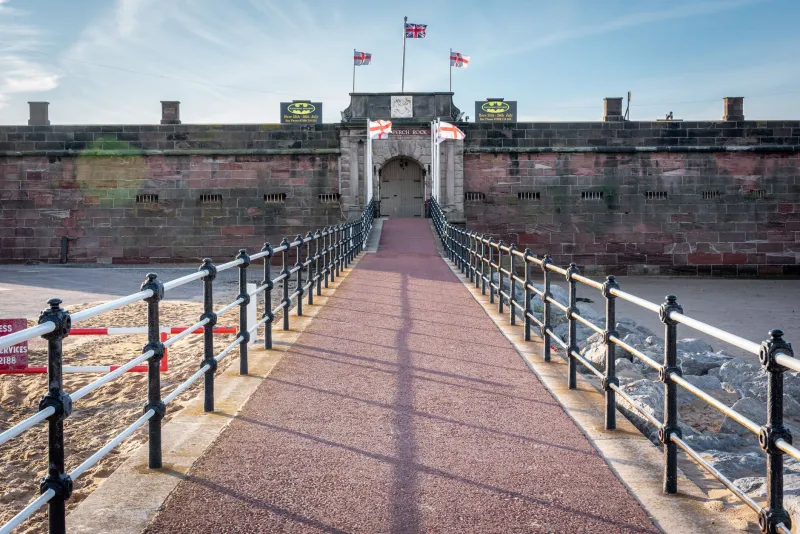
Start near the fort itself, on the seaward side where the wall meets the breakwater. Stand with your back to the road and just listen for two minutes. You will probably hear wind first — a flat, papery sound as it drags across the stone. Then the smaller stuff starts arriving: a loose fitting tapping somewhere above you, the crunch of grit under someone’s shoe, a gull arguing with another gull about nothing in particular.
The fort was built in the 1820s to guard the approach to Liverpool, and this spot still feels like a working edge. Listen for the low thrum of a ferry engine out on the river. It is not a romantic sound. It is a practical one: a reminder that the Mersey is a road, not a backdrop. The clang of harbour hardware — a halyard, a gate, a chain — tells the same story. People are still moving things across this water.
Stop two: the breakwater and lighthouse end
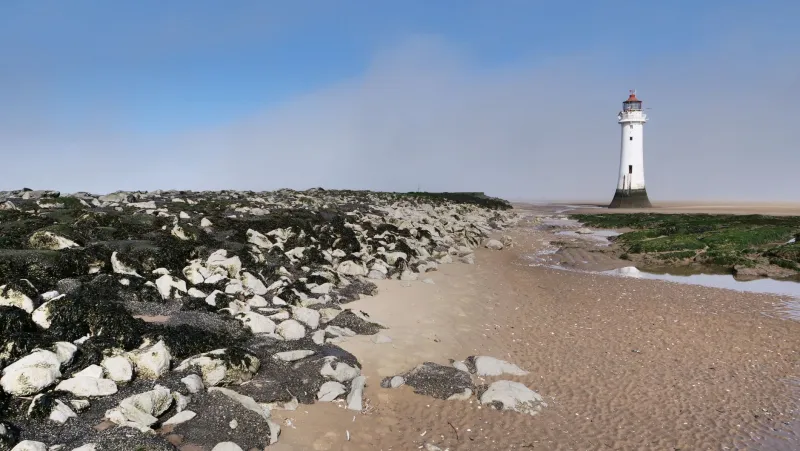
Walk towards the lighthouse and find a spot where you can hear the water meet the rocks. This is the section to save for a turning tide. When the Mersey starts to push back in, it does not arrive with a crash. It arrives with a series of small, busy sounds: water gurgling through gaps, pebbles shifting, a wet slap against stone. It is the sound of the coast doing its daily housekeeping.
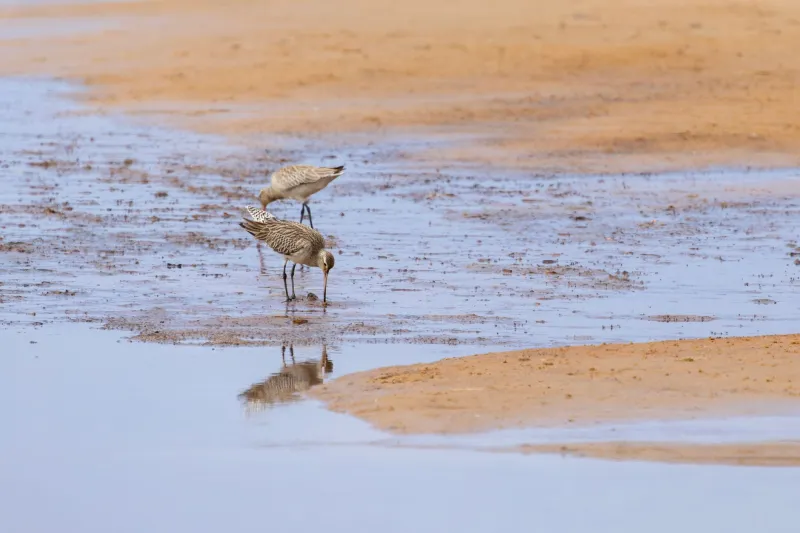
Gulls dominate here, obviously. Try not to tune them out. There is a difference between the lazy, circling call of a bird riding the wind and the sharp, urgent noise of one that has spotted a chip. Both are part of the New Brighton experience. So is the occasional bark of a dog, the zip of a coat and the distant bounce of a football.
Stop three: the promenade and marine lake
Head back along the promenade towards the marine lake. This is the people bit of the trail. Listen to the change in surface underfoot: concrete, then tarmac, then the softer sound of sand or grit. You will hear snippets of conversation, prams rattling, a skateboard, maybe the tinny music from a café. The marine lake itself has a lovely, enclosed sound — water slapping against the edge, a pedal boat creaking, the wind snatching at a flag.
This is where the fort’s story as a seaside resort sits alongside its military past. The fort was never just a defensive object; it became part of a day out. The sounds here are the sounds of leisure: families, dogs, ice cream vans, the occasional burst of someone’s phone. It is a reminder that heritage sites do not exist in glass cases. They get walked past, sat on, photographed and ignored by people eating chips.
Stop four: back at the fort
Finish where you started, but sit down this time. The fort is a good place to hear layers. Closest to you: your own breathing, the rustle of a coat. A bit further: footsteps, voices, a car door. Further still: the river, the wind, the gulls. If the fort is hosting an event, you might get music or chatter drifting out. If it is quiet, you get the strange, hollow presence of a big stone building doing nothing much at all.
That is the point of a listening walk. You are not trying to hear a script. You are trying to notice what is already there. The fort has been a defence, a venue, a landmark and a place to shelter from the rain. All of those things leave a sound behind, even if it is only the wind finding a new gap in the masonry.
Make it work for you
Keep your phone in your pocket. If you want to record, do it in short bursts, but try a few minutes without. Walk slowly. Stop at benches and railings. Do not stand in the middle of the promenade blocking cyclists. Check the tide and the weather, wear something windproof, and bring a flask. The best listening walks are the ones where you give yourself permission to be a bit aimless.
And if you only remember one thing, make it this: Fort Perch Rock is not silent. It is full of small, working noises. You just have to stop long enough to hear them.