Low Sun, Fast Water: Planning a Winter Photography Morning at Fort Perch Rock
Winter is not the season most people picture when they think of the seaside, and that is precisely why it works. Between now and February, the sun stays low over Liverpool Bay for the whole of its short shift, the promenade empties out, and Fort Perch Rock stops being a backdrop and becomes the subject. You get long shadows, wet sand acting as a mirror, and that flat grey-blue light that makes red sandstone look like it has been there since the beginning of time. You also get rain, wind and a tide that will not wait for you.
So treat this as a recce you can repeat. The plan below is for a single morning at New Brighton, built around the light and the water rather than around a checklist of shots.
First, the tide table — not the alarm clock
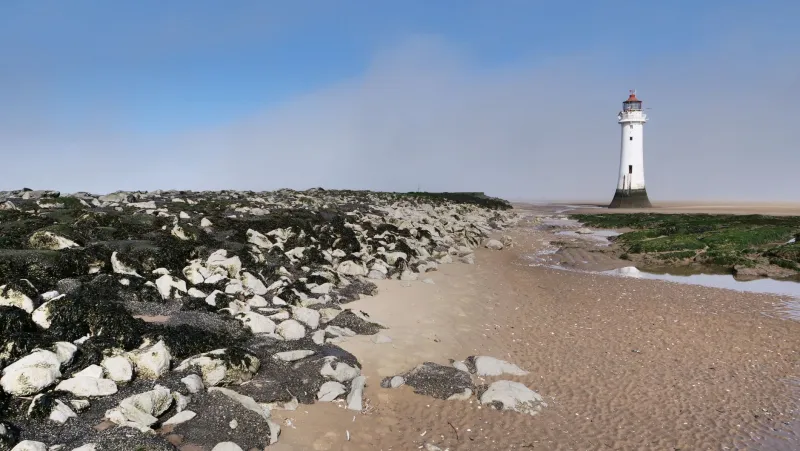
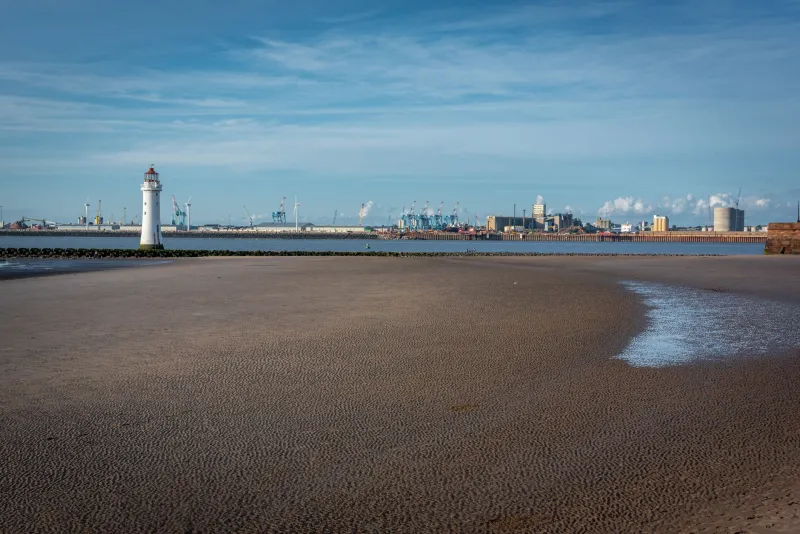
Most photography plans start with sunrise. This one starts with the tide. The whole character of Fort Perch Rock changes with the water: at high tide it sits out in the flow with the waves slapping at its base, and at low tide you get acres of wet sand, exposed rock and that glorious reflective sheen.
New Brighton's tides run on the same broad rhythm as Liverpool's, and the range is big. Check a reliable tide table for the day you plan to visit — a Liverpool or New Brighton table will both do the job — and work out two things: when high water falls, and when low water falls. Give yourself roughly an hour either side of the turn for the safest and most photogenic conditions.
If high tide lands at a sociable hour, take it. If it lands at three in the morning, do not force it; aim instead for the hour after low water, when the sand is still glossy and you can move around the base of the fort without drama.
Know the sunrise before you set the alarm
In early November, sunrise around the Wirral is roughly half seven in the morning and sunset around twenty past four. By mid-December you are looking at something nearer quarter past eight and just before four. That is a short day, and it means the golden hour is not a bonus at the end of a session; it is most of the session.
Arrive in the half-light, before the sun clears the rooftops behind you. The sky over Liverpool often does more interesting things in the twenty minutes before sunrise than in the two hours after it, and the fort silhouetted against a colour-washed sky is the shot most visitors never get because they are still in bed.
A realistic morning, hour by hour
06:45 — park up and walk the front. Marine Promenade and the streets behind it are quiet at this hour. Walk the length of the railings first with no camera out. Note where the wind is coming from and which way the water is pushing.
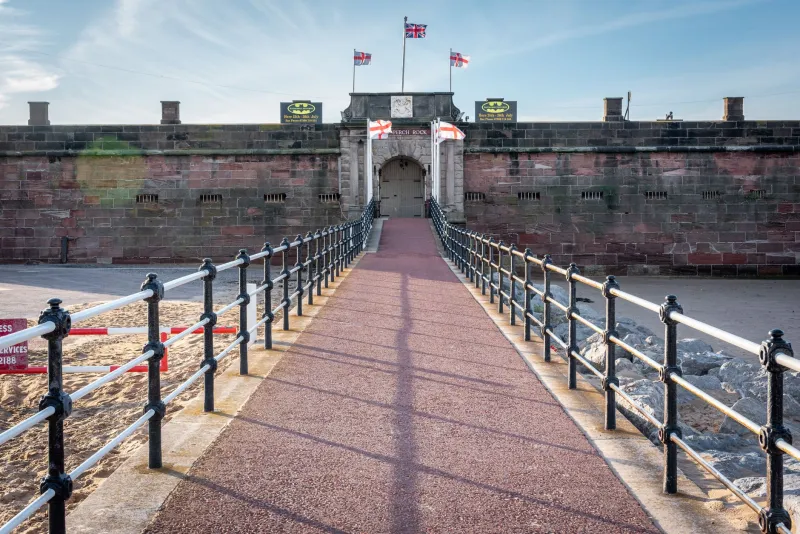
07:15 — the landward side. Before the sun is properly up, head round to the back of the fort. This is where the ditch and the bridge are, and it is far and away the more interesting face. In flat light, the texture of the stone and the geometry of the entrance do the work.
07:40 — first light on the water. Get back to the promenade side and shoot into the sunrise with the fort as a dark shape. Under-expose a little to keep the colour in the sky and let the building go black. It is a cliché for a reason: it works.
08:15 — low-tide wandering, if the water allows. If the tide is out and falling, the beach opens up and you can get angles from below, with wet sand reflecting the fort and the lighthouse together. Stay off soft mud, keep an eye on the water at all times, and never walk out towards the Rock when the tide has turned.
09:00 — coffee and a thaw. More on that below.
Safe viewpoints along the front
There are more good angles here than there are safe places to stand, so be honest with yourself about conditions.
- The promenade railings between the Marine Lake and the fort give you the classic view, plus a raised step that helps on a big tide.
- The Marine Lake side looks back across the water and works well when the wind is from the west and spray is coming over the front.
- The higher ground by Vale Park is the fallback on a genuinely filthy morning, offering a longer lens view down onto the fort and the lighthouse without getting sandblasted.
- The beach itself is only a sensible option on a falling tide, in daylight, with proper footwear. The sand here is fast and the channels fill quickly. In a westerly blow, waves can come over the promenade, so keep back from the edge.
If the wind is strong enough to make you hold onto the railings, it is strong enough to ruin your lens and put you in the water. Walk away and come back another day.
Hands, batteries and the small miseries
Winter photography on the coast is mostly a fight with your own fingers. A thin pair of gloves you can operate a dial in beats thick ones you have to keep taking off. Bring a microfibre cloth and accept that you will be wiping salt spray off the front element roughly every four minutes. Spare batteries live in an inside pocket, because cold drains them faster than you would like. A lightweight tripod helps for the pre-dawn frames; a plastic bag and an elastic band is a perfectly respectable rain cover.
And wear more than you think. The front at New Brighton in November is a wind tunnel with a view.
The warming-up bit
The best part of a winter morning shoot is the moment the camera goes in the bag. New Brighton has plenty of options: the cafés and restaurants around Marine Point, and the independent places along Victoria Road a few minutes inland, where you can get a proper coffee and something hot enough to restore feeling to your hands. If you have timed it well, you will be indoors before the rain arrives, looking at the fort through the window and feeling slightly smug.
If the weather refuses to play
It often will. Late 2026 on the Wirral can serve up a flat grey murk that turns every frame to dishwater, and no amount of tide planning fixes it. Two consolations. First, grey skies are excellent for detail: the fort's stonework, the ironwork, the wet promenade all photograph beautifully in soft light. Second, the fort runs events through the winter months, so a washed-out morning can still end with something worth seeing indoors.
Book the morning, check the tides, accept the forecast, and go anyway. The coast in winter rarely gives you the shot you planned, and it quite often gives you a better one.