Angles, Magazines and Murder Holes: Reading Fort Perch Rock's Defences Like a Soldier
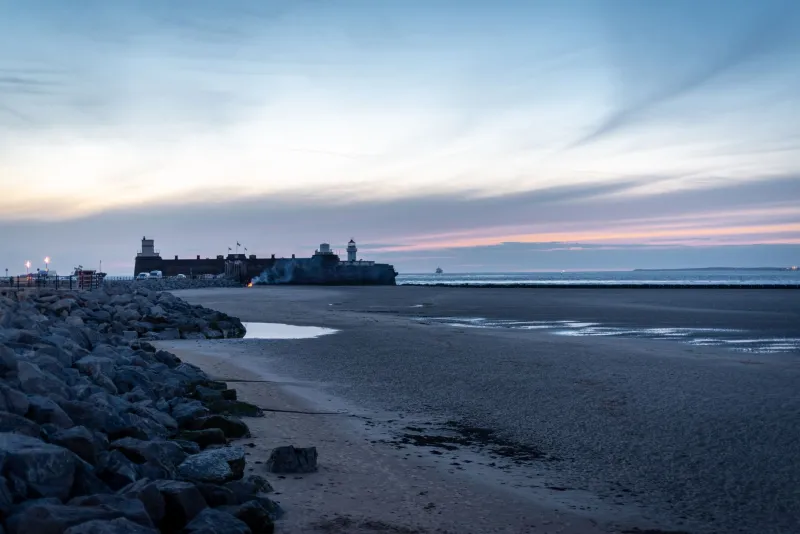
Most people meet Fort Perch Rock side-on. From the promenade at New Brighton it reads as a piece of seaside furniture: a red sandstone drum with a flag on the roof, handy as a backdrop for a photograph and as a marker for the café. Walk round to the landward face, though, and the mood changes. There is a ditch. There is a narrow bridge. There are slots in the wall above the entrance, positioned for dropping unpleasant things on anyone trying to force their way in. Whatever else it is now, this place was built to say no.
Here is what the working parts of the fort were actually for, and what a curious day-tripper can still pick out on site.
Why Liverpool suddenly needed a fort
By the early nineteenth century Liverpool was handling a colossal share of Britain's trade, and its seaward defences were, to put it kindly, thin. The Napoleonic Wars had already exposed the problem: French privateers prowling the Irish Sea, alarms along the coast, and a port worth a fortune sitting behind little more than sandbanks and good intentions. The war with America in 1812 kept the worry alive. Various schemes were floated, money was found late, and building work finally began in 1825 — the year the first stone was laid on the rock.
The fort was designed by Captain James Kitson of the Royal Engineers, and it was finished by around 1829. So yes, the timing is awkward for the headline. The fort that was planned with Napoleon in mind went up after he was gone. That does not make it pointless; it makes it insurance, bought by a city that had just discovered how exposed it was.
Why build on a rock in the middle of the channel
The site is the whole argument. Perch Rock is a sandstone outcrop sitting near the mouth of the Mersey, close to the narrowest workable passage into the river. Put guns there and any ship hoping to slip up towards Liverpool has to pass within range of them, or take a long and risky detour. Put guns on the shore instead and the channel is wide enough to make life awkward.
Building out on the rock had its costs. Foundations had to be cut and levelled; the highest tides wash right up to it; and a garrison stationed there was effectively on an island whenever the water came in. You can still feel that isolation on a rough day, when the wind comes off the Irish Sea and the Liverpool skyline looks a very long way away.
The polygon puzzle: why not a square?
A square or rectangular fort has four faces and four corners, and every corner is a place where an attacker can tuck in out of the line of fire. Fort Perch Rock is polygonal instead, with angled faces that let defenders cover the ground in front of their neighbours. Angles also mean incoming shot tends to strike at a slant rather than square on, which is a small mercy for masonry but a real one.
The walls are thick, but the cleverness is in the details. Look at the gun openings, or embrasures, cut through the stone. Each one is a deliberate funnel: wide on the outside to give the crew room to work the gun, narrow on the inside to give the men behind it as much cover as possible. Once you notice the shape, you cannot un-notice it.
Casemates: guns with a roof over their heads
Some of the fort's guns stood on the open roof platform, where they had a fine view and no protection whatsoever from weather or incoming fire. Others sat in casemates — vaulted, roofed positions built into the body of the fort. These were the practical ones. A gun crew inside could keep working through rain, sleet and spray, and could serve the piece without being picked off from outside.
The trade-off was smoke. Black powder in a confined stone room produces a great deal of it, and ventilation was a constant headache in forts of this period. Imagine the space full of men, noise and fumes and you have a fair idea of what action would have been like. That you can now stand in these same spaces, dry and unhurried, is one of the quiet pleasures of a visit.
The magazine, where one spark was everything
The powder magazine was the most carefully handled room in the whole building, and for obvious reasons. It sat deep and separate, reached by its own passage, kept as dry as possible, and fitted out to avoid anything that might throw a spark: brass and copper rather than iron where tools and fittings were concerned, and strict rules about what came through the door.
When you look at a magazine on a heritage site, you are looking at a room designed around a single fear. Everything about its position, its walls and its access is about keeping fire and impact away from a few barrels of black powder. It is not glamorous. It is the most sensible thing in the fort.
Ditch, bridge and the last few feet
The dry ditch around the landward side is there to make the walls taller than they really are and to slow anyone crossing it. The bridge over it was designed to be lifted or drawn back, turning a short walk into a cliff. And above the entrance, the slots and openings in the stonework — often cheerfully described as murder holes — allowed defenders to deal with anyone who made it that far and got stuck at the door.
This is the point in a fort's life where it is weakest: men bunched up, a gate that has to be opened, and no room to swing a weapon. Every feature around the entrance is a response to that one awkward moment.
Cold, damp and thoroughly bored
A garrison lived here, and the domestic side of the fort is easy to overlook. There were barrack rooms, stores, a cookhouse and all the small infrastructure of a place where dozens of men ate, slept and waited. It cannot have been a cheerful posting. The wind off the water, the damp stone, the tide cutting you off from town — the romance of the thing wears off fast when your boots are wet in February.
A fort that never fired a shot in anger
Fort Perch Rock's great anti-climax is that it never fired a shot in anger. By the time it was finished, steam power, iron ships and rifled guns were already rewriting the rules, and a masonry fort guarding a river mouth was becoming yesterday's answer. Its later career was quieter: training, storage, coastal defence duties during the Second World War, and damage from bombing during the Liverpool Blitz.
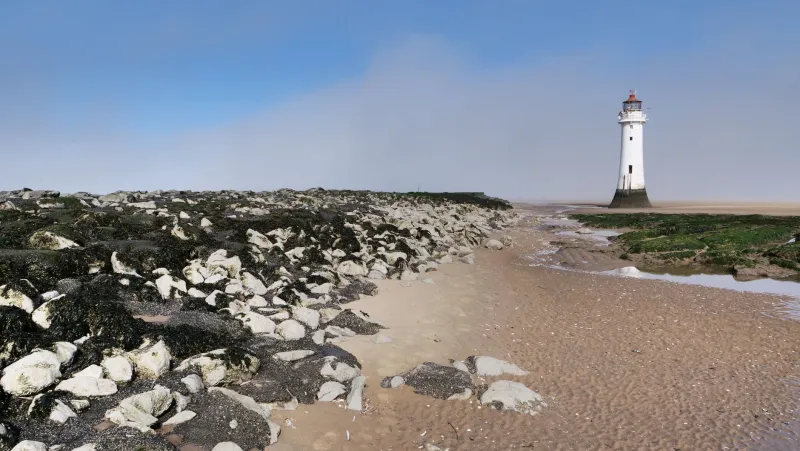
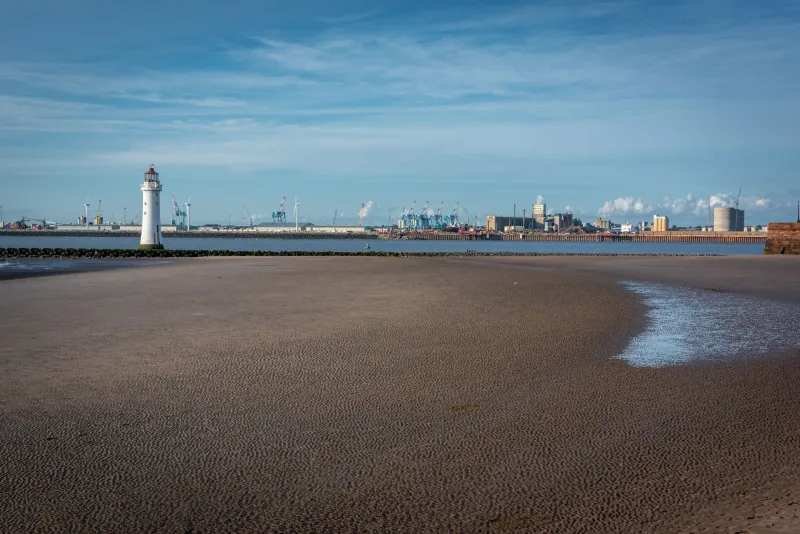
Its neighbour, the slender New Brighton lighthouse on the same rock, was lit in 1830 and did the more visible job for far longer.
What to look for on your visit
You do not need a guidebook to read the fort, just a slow lap and a bit of curiosity.
- The embrasures. Count them, and notice how the openings change shape as they pass through the wall.
- The ditch and bridge on the landward side. This is the side that makes the fort make sense.
- The vaulted casemate spaces. Look up at the brick and stone and think about the smoke.
- The roof platform. The view across the Mersey to Liverpool is the reason the site was chosen; seeing it explains more than any plaque.
- The stone itself. Red sandstone, weathered, patched and salt-stained. Some of the most honest history on the Wirral coast is just in the surface of the walls.
If you go
Fort Perch Rock sits on Marine Promenade at New Brighton, a short walk from New Brighton rail station and well served by buses from Wallasey and Birkenhead. It is a scheduled monument and a working visitor attraction, so opening times vary through the year and around events — check before travelling, especially out of season. Tides matter here more than at most coastal sites: the beach around the rock fills quickly, and the fort looks completely different at high water. There is food and drink on site and plenty more along the front.
Give it an hour, take the landward path first, and let the engineering do the talking.