Rough Lines, Big Sky: Learning to Sketch Fort Perch Rock in a Single Morning
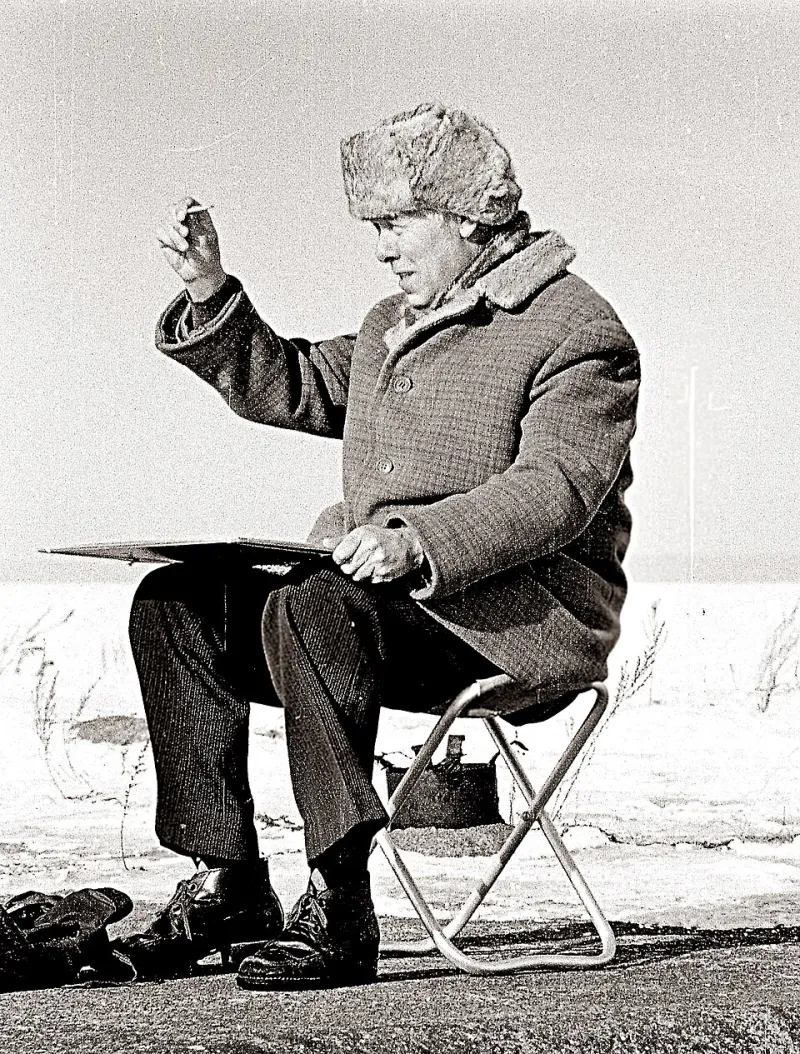
Photo: Vitold Muratov, CC BY-SA 4.0, via Wikimedia Commons
There is a particular kind of person who arrives at Fort Perch Rock, takes about forty photographs, and then stands there looking faintly robbed. They wanted to make something, not just record it. If that sounds familiar, this is for you. Sketching the fort is not a talent reserved for people with a portfolio and a folding stool. It is mostly a matter of standing in the right place, at the right state of tide, with the right amount of equipment, and then agreeing to be bad at it for an hour.
Why this fort is such a patient teacher
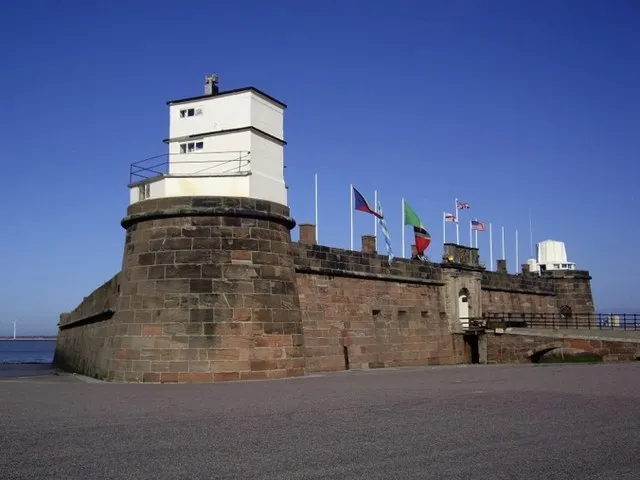
Most buildings give you one good angle and then run out of ideas. Perch Rock doesn't. The red sandstone walls are long, low and repetitive, which means you can fudge a bit of masonry and nobody will notice. The circular bastions give you curves to practise. The lighthouse sits off to one side, tall and pale, offering a vertical to argue with all that horizontal stone. And behind the whole thing is the Mersey, which does the hardest work for you — water is a free pass for any drawing, because nobody expects you to get every ripple right.
It also helps that the fort is genuinely odd-looking. Defensive architecture of the 1820s was designed to be legible from a distance — thick walls, clear silhouettes, no fiddly ornament — and legible is exactly what a beginner wants. The place is a shape before it is a building.
Pack less than you think
You will be tempted to bring everything. Don't. A small selection, chosen once and trusted, beats a rucksack full of options you never open.
- An A5 or A4 sketchbook with paper thick enough to take a light wash — 140gsm and up is plenty
- A 2B pencil and something darker, like a 4B, for the shadow under the ramparts
- A fine liner or a cheap fountain pen, if you like a firm edge
- A small watercolour pan set and a water brush, or a grey brush pen if you'd rather travel light
- A kneaded eraser — the putty sort, not a plastic brick
- A bulldog clip to stop the wind flipping your pages, and an elastic band to hold it all shut
- A waterproof wallet or a large zip bag for the whole lot
- Fingerless gloves, a thermos, and something dry to sit on
One more thing worth printing out: the tide table. Not for the drawing, for you.
Where to stand, and when
Access to the fort is a tidal business. The rock it sits on gets swallowed at high water, and the crossing is not a place to be creative about timings. Treat the tide table as part of your kit. Aim for the couple of hours either side of low water if you want to get out onto the rock itself, and give yourself a generous margin on the way back — the Mersey does not do grace periods.
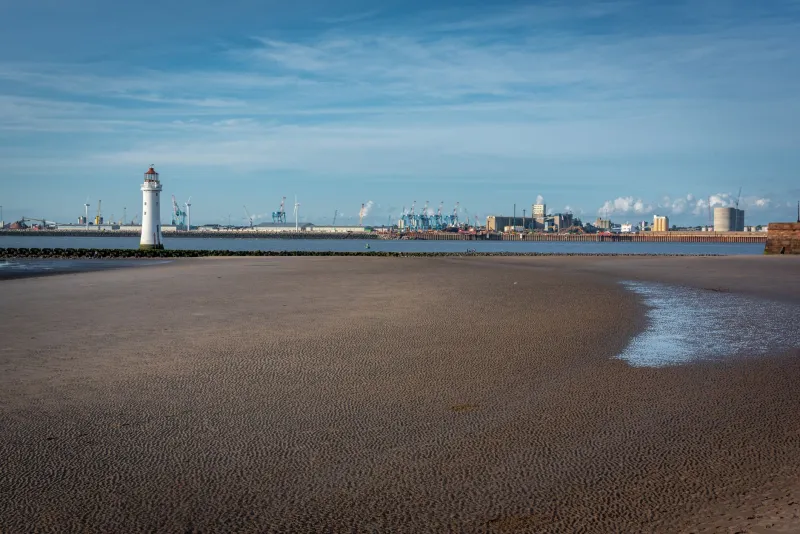
If the tide is unhelpful, don't sulk. The promenade and Marine Lake side give you excellent, safe, dry views across to the fort at any state of water, and honestly a distant view is often easier to draw than a close one. Vale Park, further along, offers a longer, calmer composition with the fort and lighthouse sitting together in one frame. From the Seacombe direction you get the whole arrangement small and neat, like a diagram of itself.
Light matters more than angle. Early morning gives you a clear, silvery river and long shadows raking across the walls. Later in the afternoon the sun swings round towards the water and the fort becomes a dark shape against a bright sky — which, for a beginner, is a gift. You can draw a silhouette convincingly with almost no skill at all.
Four lines and a wall
The trick with a building this complicated is to refuse to see it as complicated. Before you draw any stone, draw the picture as a diagram.
- The water line. One long, slightly wavering horizontal across the page, about two-thirds down. Not perfectly level — tilt it a touch and the drawing instantly feels less stiff.
- The wall. A long, low horizontal shape above the water line, broken into two or three blocks rather than one continuous bar. Keep it slightly uneven so it reads as masonry, not a fence.
- The mass. One darker vertical block where the main body of the fort sits — this is the anchor. Get this in the right place and the rest will forgive you.
- The curve. A single arc for the round bastion, laid in with a loose hand.
- The lighthouse. A slim vertical, off to one side, taller than you think it should be and narrower than you want it to be. Everyone draws it too fat. Go thinner.
Five lines. That's the skeleton. The ramparts, the embrasures, the little dark mouths of the gun ports — all of that is detail, and detail goes on last, sparingly, and only where you want the eye to go. A common beginner's mistake is drawing every window and every stone, which produces a picture that is accurate and dead. You are aiming for the opposite: a picture that is vague and alive.
Keep the lighthouse honest
There's a persistent habit of merging the fort and the lighthouse into one landmark, and sketching is where you notice why. They are two separate things doing two separate jobs, built for two separate reasons, and they sit at different distances. If you draw them both from the same imaginary plane, the picture will look flat and slightly wrong and you won't be able to say why.
Fix it by deciding which one is in front before you put pencil to paper. Say it out loud if it helps. Then draw the front one with a firmer line and the back one a shade lighter, and the whole thing will click into place.
When the Wirral weather changes its mind
It will. The forecast will say dry and the wind will arrive sideways with a message from Ireland. A few things worth knowing:
- Rain is not the end. Move under shelter — the colonnade by the lake, a café on the front, the lee side of a wall — and switch to pencil only. Watercolour and horizontal rain are not friends.
- Blot, don't scrub. A wet page smudges if you attack it. Press it, leave it, and let the mark dry into a soft grey edge. Mersey mist is a legitimate artistic device and you are now an expert in it.
- Draw the weather instead of fighting it. Fast grey clouds are easier to capture than buildings. If the sky is doing something dramatic, stop drawing stone and start drawing air.
- Finish from indoors. There is no rule that says a sketch must be completed in the presence of its subject. Take a photograph, retreat to a warm window, and resolve the darks with a coffee in your hand. Some of the best pages are finished an hour later and half a mile away.
A finished drawing is a bonus
The real product of a morning like this is not the page. It's the fact that you will walk away knowing how the fort is put together — where the wall meets the rock, how the bastion turns, which side is in shadow in November. Photographs don't teach you that. Drawing does, because drawing forces you to look at the same thing for twenty minutes instead of two seconds.
So go, sit on the prom, get the tide table wrong by ten minutes and learn from it, and come home with something wonky and personal. Stick it on the fridge. Fort Perch Rock has survived nearly two centuries of salt, wind and official indifference. It can survive your linework.