One Rock, Two Landmarks: Telling Fort Perch Rock and New Brighton Lighthouse Apart
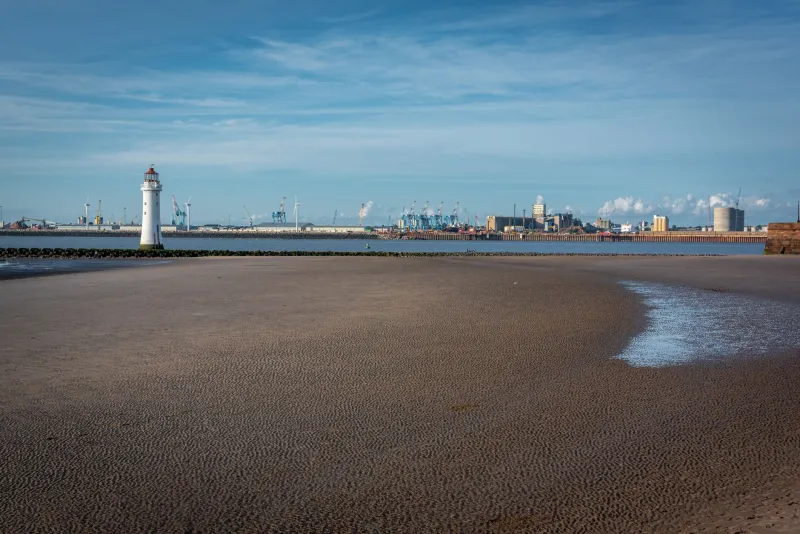
Stand at the railings on New Brighton promenade and the confusion makes sense in one glance. There is a squat granite fort doing its best to look permanent, and a slim black-and-white tower doing its best to look romantic. Both sit at the mouth of the Mersey. Both carry the name Perch Rock. And both, depending on which coach party you follow, get called 'the fort' or 'the lighthouse' by people who are not entirely sure which is which.
That is not a criticism. The two landmarks are close enough to share a view, a postcode and a good deal of photographic attention, but they are not the same thing. One is a defensive battery. The other is a navigation tower. Neither is simply 'Perch Rock', because Perch Rock is the rock itself, the tidal outcrop that made the place worth building on in the first place.
What each one actually is
Fort Perch Rock is the low, broad, granite structure closest to the promenade. It was built in the 1820s as a coastal defence battery, designed to guard the approaches to the Mersey at a time when Liverpool's docks and shipping were far too valuable to leave unguarded. It looks like a fort because it is one: thick walls, gun positions, a magazine, and a layout that was meant to withstand a serious argument. It later had roles in both world wars and is now a museum and events venue, which is why you can sometimes go inside, climb about and find a cafe where the garrison once stood.
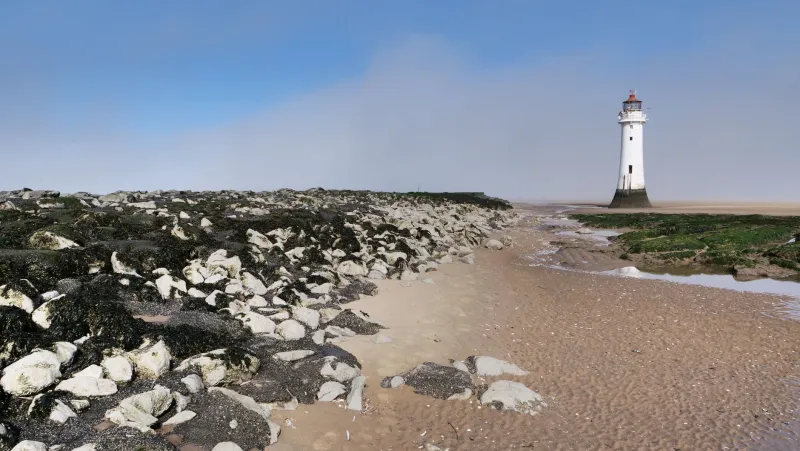
New Brighton Lighthouse, often called Perch Rock Lighthouse, is the tall tower out by the water. It was first lit in 1830 and guided shipping into the Mersey for well over a century before being retired in 1973. Its black-and-white paint scheme is the giveaway. So is the lantern room at the top. It is not a fort, it is not a museum, and it does not have a hidden tunnel to the fort, however much fun that would be. It is a lighthouse, and a very good-looking one.
Why the names get muddled
The main reason is geography. The fort and the lighthouse are neighbours on the same stretch of shore, and from some angles on the promenade they appear to be part of one compound. Add the shared name 'Perch Rock' and it is easy to assume the lighthouse is the fort's tower, or that the fort is the lighthouse's engine room.
There is also the matter of how people talk about a day out. 'We're going to Fort Perch Rock' often means the whole New Brighton waterfront, lighthouse included. 'We saw the lighthouse' often means someone stood near the fort and pointed at the tower. Social media captions blur the two further, which is how a granite battery ends up credited with a lantern room it has never possessed.
The useful distinction is simple: the fort is the place you can visit, read interpretation boards and sometimes go inside. The lighthouse is the thing you photograph from the sea wall. If you can buy a ticket and walk through a gate, you are at the fort. If you are admiring a tower against the sky and wondering how it stays upright in a westerly, you are looking at the lighthouse.
A simple route for seeing both properly
Start at the Fort Perch Rock end of New Brighton promenade. Give yourself twenty minutes to walk around the outside of the fort, read the panels and get your bearings. The scale is easier to understand from the seaward side, where the granite blocks and the low profile make it clear that this was built to be practical rather than pretty.
From there, follow the promenade towards the lighthouse. You do not need a complicated map. Keep the water on one side and the town on the other, and the tower will do the rest. The best views are from the sea wall, slightly back from the railings, where you can frame the lighthouse without a forest of lamp posts in the way. On a clear day you can look across the Mersey and remember that this is a working river mouth, not just a backdrop.
Do not be tempted to walk out towards the lighthouse across the sand or the rocks. Perch Rock is tidal, the currents are serious, and the lighthouse is best admired from dry land. The promenade route is short, flat and suitable for most visitors, with plenty of benches if the wind is doing its usual impression of a ship's horn.
To finish, loop back towards Marine Point for a coffee or a late lunch. The whole walk is easily under an hour at a gentle pace, which leaves time for the arcades, the marine lake or simply another look at the fort as the light changes.
Quick identification for the next time
- Low, wide and granite: Fort Perch Rock.
- Tall, slim and black-and-white: New Brighton Lighthouse.
- Has a museum, events and sometimes a cafe: the fort.
- Has a lantern room and no gift shop: the lighthouse.
- Sits on Perch Rock: both of them, which is exactly why the names stick.
For a 2026 day out, the pleasure is in seeing them as a pair rather than choosing one. The fort tells you about defence, trade and the serious business of guarding a river. The lighthouse tells you about navigation, weather and the thousands of ships that needed a clear mark to aim for. Together they explain why this small rocky point on the Wirral coast mattered far more than its size suggests.
So if you arrive expecting one landmark and leave photographing another, you are in good company. Just remember: the fort is the granite one you can visit, the lighthouse is the tower you photograph, and Perch Rock is the rock beneath them both. Once you have that straight, the whole shoreline makes a lot more sense.