Rising from the Tide: How Victorian Engineers Planted a Fort on Perch Rock
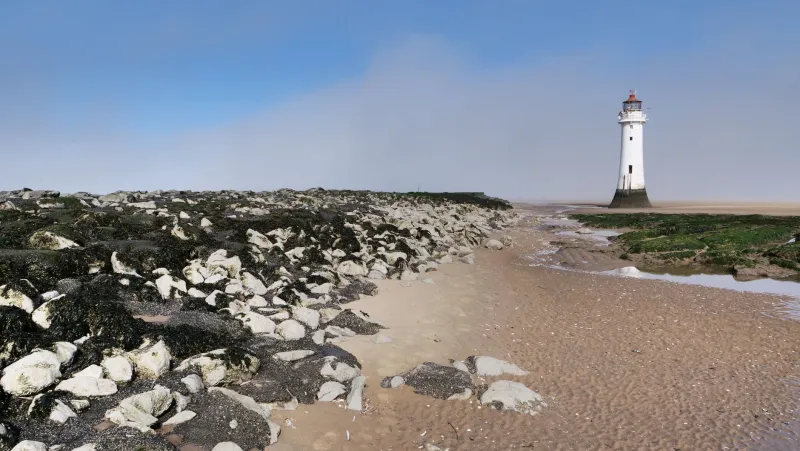
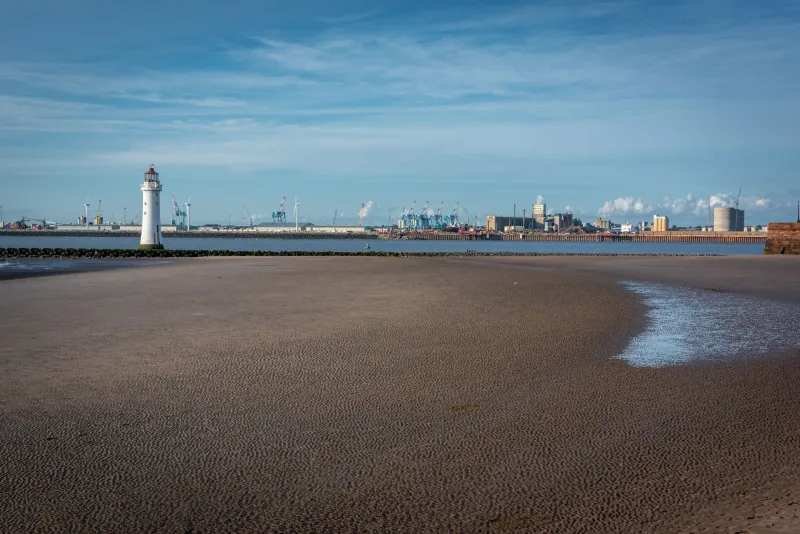
Stand on the New Brighton promenade at low water and Fort Perch Rock can look almost ordinary: a squat, solid presence with the lighthouse nearby and the Mersey doing its usual grey-green shuffle. Wait a few hours, though, and the rock beneath the fort disappears. The tide swallows the approach, the beach goes, and the fort looks less like a building and more like a stubborn thought in the middle of the river.
That is the clue to its construction. Fort Perch Rock was built between 1826 and 1829 on a tidal sandstone outcrop, not on a convenient empty field. The engineers were not simply designing a defensive structure. They were solving a problem in time, water and logistics. The result is a fort that feels permanent, but only because a lot of people worked very hard to pretend the sea was not there.
A rock that kept disappearing
Perch Rock itself is the starting point. It sits at the mouth of the Mersey, close to the New Brighton shore, and it is covered by the tide for part of every day. That single fact shaped the entire project. You cannot dig a normal foundation trench on a site that is sometimes under water. You cannot leave materials lying about and hope the weather stays kind. Every job had to be fitted into the low-water window, and every low-water window had a deadline set by the moon.
Modern construction loves a dry site. Victorian engineers had to work with the opposite. They would have used the exposed rock when they could, built up from it, and protected their work as the water returned. The exact sequence is not always easy to recover from the records, but the principle is clear: the tide was the foreman.
Thinking in tidal windows
The first engineering problem was not the fort. It was the timetable. A site that is dry for a few hours and then several feet under water changes how you plan everything. Materials had to arrive when the tide allowed. They had to be stored above the reach of the next flood. They had to be fixed in place before the water came back. That means staging, barges, horses, hand tools and a great deal of human muscle.
There were no concrete pumps, no tower cranes and no laser levels. There were ropes, timber, iron, stone and experience. Builders of this period were used to working in harbours and docks, where tides were a normal part of the day. Fort Perch Rock took that ordinary harbour knowledge and pushed it a little further, because the site was not just wet. It was exposed.
Materials that could take a soaking
Salt water is unkind to buildings. It gets into stone, attacks mortar and rusts iron. A fort on a tidal rock had to be built with that in mind. The walls are thick, the profile is low and the whole structure sits heavily into its base. That is partly a military decision, of course. A low, massive fort is harder to knock about than a tall, elegant one. But it is also a practical decision on a site where wind and water do their best to find weakness.
Stone and brick do much of the visual work, held together with mortar and backed up by the sheer weight of the construction. The fort does not float above the rock. It belongs to it. Look at the way the walls meet the base, and you can see the logic: use the rock as part of the foundation, then build up in a way that can tolerate spray, damp and the occasional serious soaking.
The supply chain was the real battle
A fort is a warehouse of materials before it is a fort. Stone, lime, timber, iron, tools, food for the workforce and fuel for the fires all had to reach the site. Liverpool was growing fast in the 1820s, and the Mersey was a busy working river. Every barge and boat involved in the build had to fit around shipping, weather and the tide.
That is where the sheer logistical ingenuity comes in. The builders were not just constructing a fort. They were running a small port. Materials had to be landed, moved, stacked and fixed in a sequence that made sense. Get it wrong and you lose a day, or a week, or a delivery. Get it right and the fort rises a little more with every tide.
What the builders left for us to read
You do not need to be an engineer to enjoy this side of Fort Perch Rock. Next time you visit, look at the base rather than the battlements. Look for tide lines, discolouration, patched stone and the way the fort seems to grow out of the rock. Look at the thickness of the walls and think about the weight above them. Look at the narrow windows and the low profile, and remember that every opening had to be built by hand in a place that was sometimes sea.
The fort was never just a defensive box. It was a statement about what Victorian engineers could do when they refused to accept a difficult site as a reason to stop. The Mersey gave them a rock, a tide and a deadline. They gave it a fort.