Saved by Stubbornness: The Long, Unglamorous Campaign That Kept Fort Perch Rock Standing
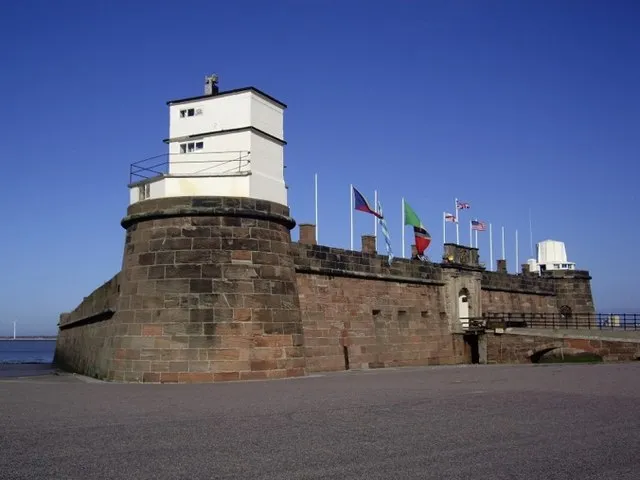
Photo: Tom Pennington, CC BY-SA 2.0, via Wikimedia Commons
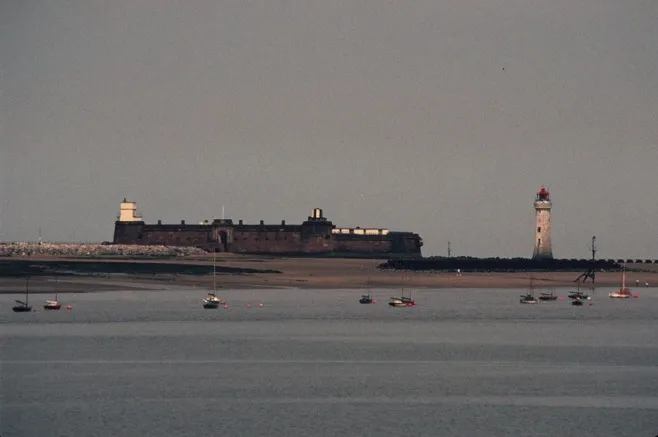
Walk out along the Marine Promenade on a grey November morning and the fort does what it has always done: it sits there, immovable, taking the weather. It is easy to read that solidity as permanence. It isn't. There were years — not so very long ago — when the paperwork could plausibly have gone the other way, and the strange little fort on the Rock Channel could have become a memory, a handful of photographs, and a name on a housing estate.
A fort with nothing left to defend
Built between 1825 and 1829 to see off a French invasion that never came, Fort Perch Rock spent its working life solving a problem that kept failing to arrive. By the time the Second World War had come and gone, its guns were obsolete, its role was gone, and the military had other things to think about. Coastal artillery had been superseded by aircraft and missiles; a squat sandstone battery at the mouth of the Mersey was, in the cold language of the disposal office, surplus to requirements.
What followed was the classic heritage-site drift. A caretaker here, a padlocked gate there. Damp getting into the casemates. Pigeons discovering the gun emplacements. The fort's fabric — that wonderful, unforgiving sandstone — does not rot so much as it spalls, flakes and quietly surrenders, and a decade of neglect can do more damage than a century of gales.
Reading the clippings
If you spend an afternoon in the local studies collection at Wallasey, or scrolling through digitised editions of the Wirral newspapers, a pattern emerges. Through the 1960s and 1970s the fort turns up in print again and again, and almost always in the same register: what are we going to do with it? There are wistful pieces about its history, indignant pieces about its condition, and the occasional letter from a reader who clearly loved the place and could not bear to see it fenced off and going green.
Talk of demolition was in the air — not as a concrete plan, but as the default option that nobody had yet ruled out. That is how buildings are lost in Britain. Rarely by a single act of vandalism; far more often by a long, shrugging absence of anyone willing to argue the other side.
What the clippings also show is how quickly the argument changed once people started using the building. A fort with a purpose — even a modest one, even a slightly ramshackle one — is a fort with a lobby. A fort standing empty behind a chain-link fence is a fort with a problem.
What actually saved it
It would be tidy to say there was a single saviour. There wasn't. The honest answer is that Fort Perch Rock survived because a number of separate, unglamorous efforts happened to overlap.
The first was sheer architectural stubbornness. The fort is a listed building, and that designation matters enormously: it means that demolition stops being a decision someone can simply take and becomes a process somebody has to argue for in public. Listing does not save a building on its own, but it buys time, and time is what heritage sites most often need.
The second was the arrival of people willing to take on the lease and make something of the place — turning empty casemates into a museum, putting a roof back where a roof belonged, opening the gates on a Sunday and charging a few pence to come in. Anybody who has run a small visitor attraction will tell you the same thing: the first year is enthusiasm, the second is accounts, and the third is plumbing. Fort Perch Rock has been through all three, several times.
The third, and the least visible, was the local habit of caring. Letters to the paper. Questions at council meetings. Photographs taken and kept. A school project here, a historical society there. None of it looks like a campaign while it's happening. All of it adds up to a constituency — and a constituency is what a building needs when somebody with a clipboard suggests a car park.
The economics of keeping a fort
Let's be realistic, because heritage writing is often too sentimental about this. Fort Perch Rock is not a cash machine. It is a thick-walled, unheated, awkwardly shaped building on a promenade, exposed to everything the Irish Sea can throw at it, with limited parking and a tidal causeway that does not care about your booking. Every penny of maintenance is hard-won, and the salt in the air means the work is never finished.
That is precisely why the volunteer culture around the fort matters so much. The people who open up, sell the tickets, fix the door that has swollen in the damp, and answer the same question about the lighthouse for the fortieth time that week — they are not a nice extra on top of the business model. In many small heritage sites they are the business model. In 2026, with local authority budgets across the Wirral under the sort of pressure everyone reading this already knows about, that reliance is not going to get lighter.
What the Wirral coast should take from it
There is a version of this story that ends with a plaque and a warm feeling. The more useful version ends with a question: what else along this coastline is currently in its own quiet, shrugging phase?
The lesson from Perch Rock is not 'somebody will save it'. It is that buildings are saved by a sequence of small, boring, cumulative acts — a listing application, a lease, a Sunday opening, a letter to the paper, a school visit, a photograph kept in a drawer. None of those is dramatic. Together they are the difference between a landmark and a memory.
So next time you're down at New Brighton, with the wind coming off the Mersey and the lighthouse doing its thing across the water, look back at the fort. It looks permanent. It isn't, quite. It is maintained — by argument, by stubbornness, and by people who decided, at some point in the last fifty years, that this odd, heavy, slightly ridiculous building was worth the bother.
Go in. Buy the ticket. That's how it carries on.