The Slow Argument Between Sea and Stone: Reading Fort Perch Rock's Outer Skin

Photo: Photograph by Mike Peel (www.mikepeel.net)., CC BY-SA 4.0, via Wikimedia Commons
Fort Perch Rock is easy to admire from a distance. From the prom, it looks solid, stubborn, almost inevitable — a squat sandstone statement planted where the Mersey meets the sea. Get closer, though, and the fort stops being a single object and becomes a collection of small arguments. Salt against stone. Wind against iron. Old repairs against new weather. A conservation Walk around the outside is less about ticking off features and more about learning to read those arguments as they happen.
You do not need special knowledge to do this. You need a decent pair of shoes, a eye for detail, and a willingness to slow down. The fort's exterior is a notebook written in mineral, rust and mortar. Once you start noticing, it is hard to stop.
Start Where the Sea Gets a First Word
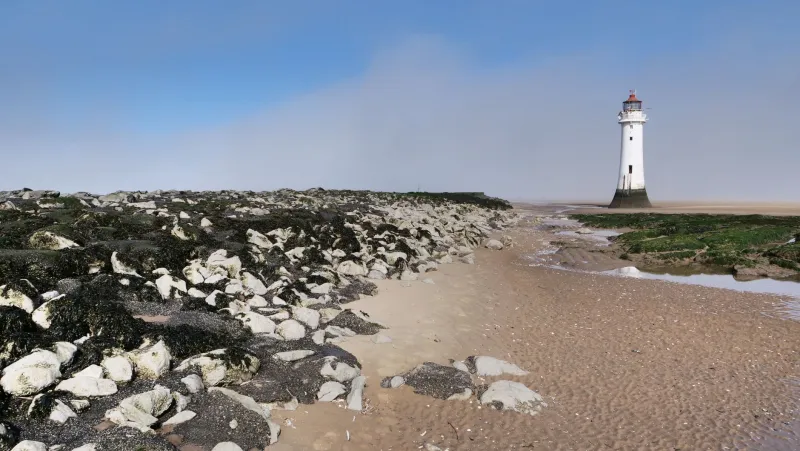
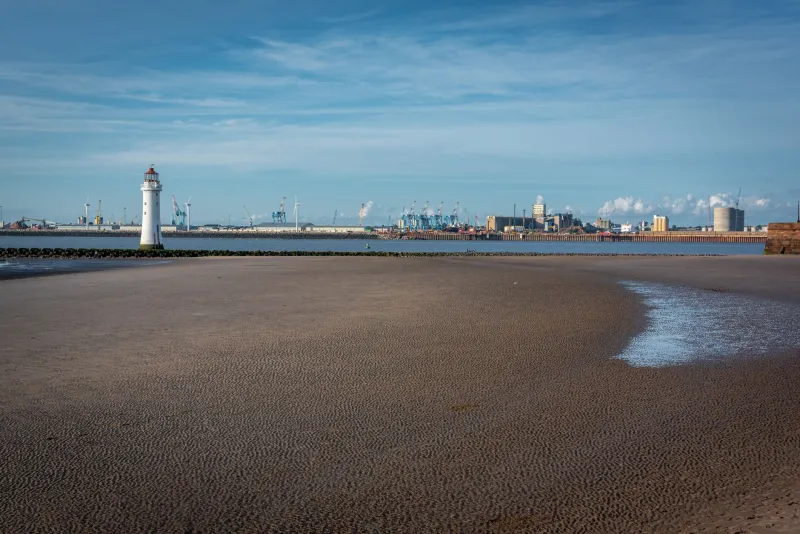
Begin on the approach, before you reach the fort proper. The causeway and the surrounding breakwater give you the broad view: the fort sitting low, the lighthouse nearby, the shipping lane beyond. This is the moment to think about exposure. Perch Rock is not sheltered. It takes whatever the Irish Sea and the Mersey can throw at it, often sideways and usually with grit attached.
Look at the lower courses of stone as you get nearer. On the seaward side, the masonry often shows a darker, damper band — the splash zone, where wetting and drying happen over and over. Salt crystals can work into tiny pores and push outward as they form. You will not see that chemistry happening, but you can see its consequences: roughened surfaces, softened edges, places where the stone looks slightly sugared or scuffed.
This is coastal conservation in its most basic form. It is not about making the fort look new. It is about slowing the rate at which the sea can take pieces away.
The Seaward Face: Where the Weather Does Its Best Work
Walk around the seaward elevation and pay attention to the joints. Traditional lime mortar is meant to be slightly sacrificial: it flexes, breathes and erodes a little so that the harder stone behind it does not have to. When you see mortar that has weathered back, that is not necessarily failure. It is the building doing what it was designed to do.
What matters is the pattern. Deep, uniform recesses along a whole course might suggest a longer-term issue. Small, localised pockets are more like ordinary wear. Look also at the edges of buttresses, quoins and openings. Exposed corners take the wind from two directions at once, which is why they often show the first signs of rounding and loss.
Above head height, the parapet and upper surfaces are worth a long look. Rain, salt spray and wind-driven grit all arrive from above as well as from the side. Any horizontal ledge is a place where water can sit, and where plant life can find a foothold. A little green in the wrong place is not always a problem, but it is a clue about moisture.
Ironwork: The Honest Rust and the Careful Repairs
Fort Perch Rock's ironwork tells a more obvious story. Rust is a coastal constant, and the fort's railings, fixings and structural metalwork show it plainly. Look for the bloom of orange-brown staining on stone below metal fittings. That is rust migrating with rainwater — a small, visible reminder that water always finds a route.
Conservation treatment for ironwork is rarely about making it disappear. It is about stabilising, coating and monitoring. On a walk around the exterior, you can sometimes spot the difference between old, friable rust and newer, sounder metal where repairs have been carried out. The colour is not the point. The point is the edge: flaking, blistering and loss of section are the things to watch.
If you see a patch of fresh paint or a neat new fixing, resist the urge to think of it as the end of the story. In a coastal environment, every repair is a temporary truce. The wind will get back to work.
Mortar, Stone and the Art of Letting Go Gracefully
Repointing is one of the least glamorous parts of conservation and one of the most important. Look closely at the mortar between stones. Is it proud, flush or recessed? Does it look softer or harder than the stone around it? A hard cement mortar in an old coastal building can be a problem, because it traps moisture and forces the stone to take the punishment instead.
On a good conservation walk, you are not looking for perfection. You are looking for compatibility. The right mortar is the one that weathers a little, holds the stone in place and does not pretend the sea is not there.
Keep an eye out, too, for exposed edges where stone has been lost. Sometimes the answer is to replace a block; sometimes it is to shelter, consolidate or simply record the change. Coastal conservation at Perch Rock is a long conversation, not a single fix.
A Walk You Can Do in an Hour
You do not need a guided tour to notice any of this. A simple loop works well: start at the landward approach, follow the seaward face, then return along the sheltered side. Pause at corners, ledges and any place where metal meets stone. Look up, look down, and look at the joints rather than the big picture.
Check the tide first, as ever at Perch Rock. The fort is not a place to get cut off, and the best views of the exterior are not worth a soaking or worse. Take a camera if you like — low winter sun is brilliant for showing texture — but leave the hammer and the scraping tool at home. This is a looking walk, not a touching-and-poking walk.
Why the Job Never Ends
By the time you complete the loop, the fort may look less like a monument and more like a patient. Not a failing one — a patient with a long history of good care, sensible interventions and the occasional set-back. The salt will keep arriving. The wind will keep pushing. The iron will keep wanting to return to its natural state.
That is the real lesson of a conservation walk around Fort Perch Rock. The building is not finished. It is being maintained. And every visitor who takes the time to look closely is, in a small way, part of the audience for that ongoing work.